Research Interests
Focus Areas
- Nonlinear Optical Microscopy and Spectroscopy
- Ultrafast Charge-Carrier Dynamics
- Light–Matter Interactions
- Interfacial Energy Transport
My research is driven by a question:
In functional materials, energy flow is controlled by surface structure (crystallographic orientation, termination, and composition), symmetry, and interfacial electronic properties. My research seeks to understand how these factors shape carrier dynamics and influence material performance, ultimately guiding the rational design of next-generation functional materials and devices.
Orientation and Termination Effects on Charge Carrier Dynamics
Using ultrafast scanning electron microscopy (USEM), we investigated how crystallographic orientation and surface termination govern charge-carrier dynamics in MAPbI₃ perovskite single crystals. The results reveal strong facet-dependent transport: the (001) surface supports long-range carrier diffusion, while the (100) facet introduces defect states that accelerate recombination.
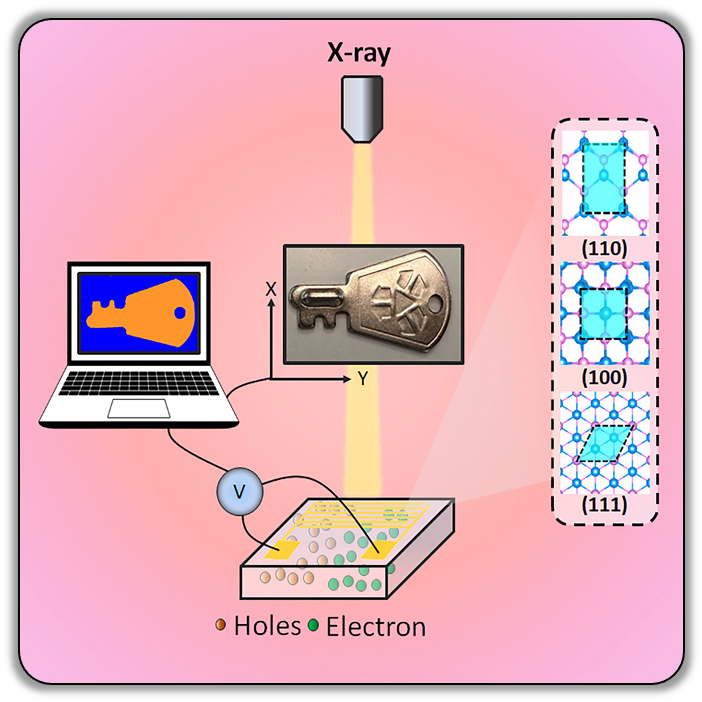
Photoinduced carrier dynamics in CdTe single crystals were investigated to understand the role of crystallographic orientation in X-ray detector performance. Devices fabricated from the (110) facet exhibit more than two orders of magnitude lower detection limits and significantly higher sensitivity compared to (100) and (111) orientations.
Composition-Dependent Carrier Dynamics
Using four-dimensional ultrafast scanning electron microscopy (4D-USEM), we investigated surface carrier dynamics in mixed-cation perovskites FA₀.₆MA₀.₄PbI₃ and FA₀.₄MA₀.₆PbI₃. The measurements reveal that small compositional changes strongly influence carrier lifetime and diffusion at the surface. In FA-rich compositions, iodide migration can dynamically passivate surface vacancies, reducing non-radiative recombination and enabling longer-lived carriers. These results highlight how ion migration and surface chemistry together govern carrier dynamics in hybrid perovskites.
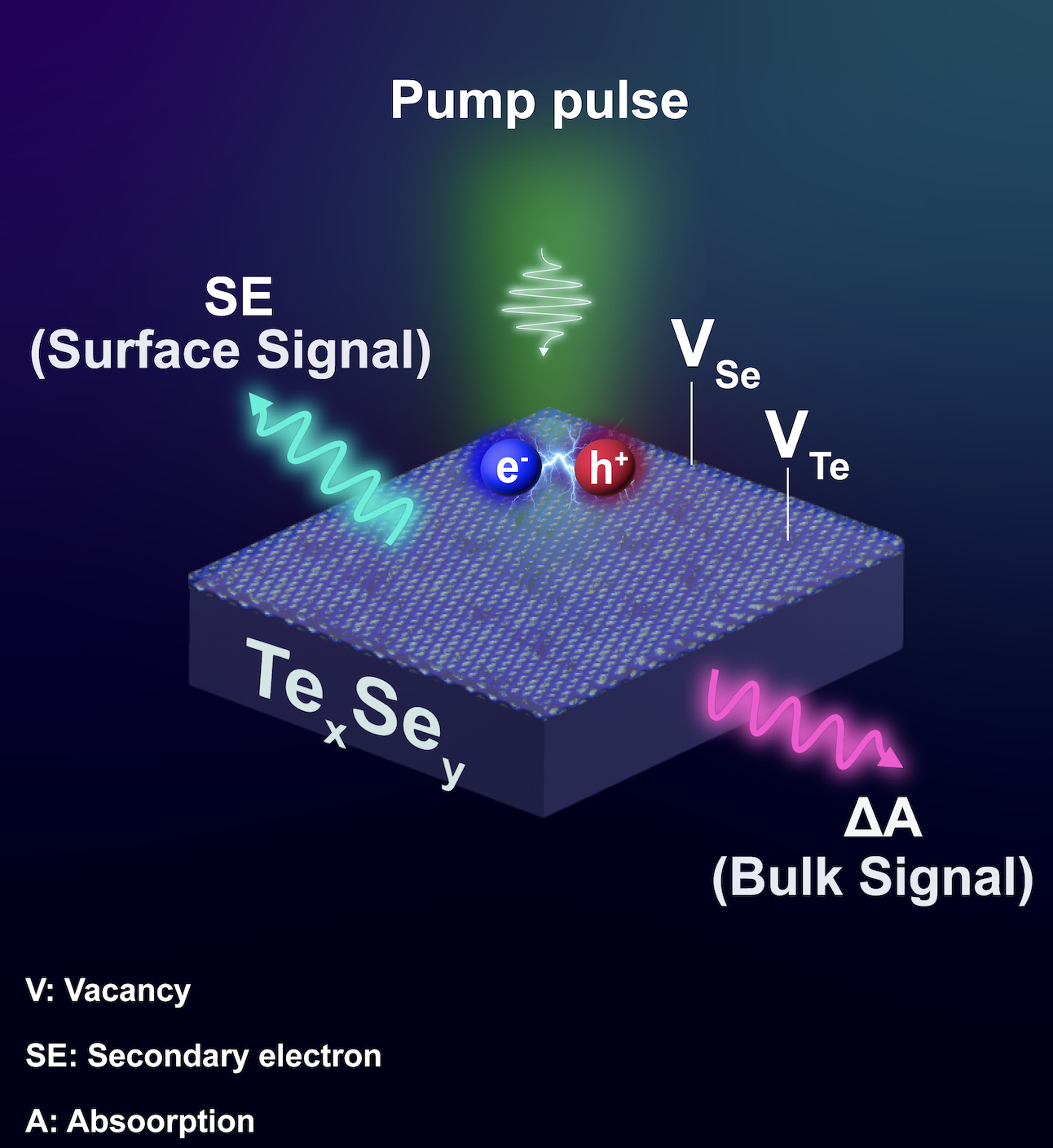
We studied how composition influences surface carrier transport in Te-Se nanocomposites using ultrafast electron microscopy. The results reveal distinct dynamical regimes: TeSe (1:0.5) supports long-range carrier diffusion, whereas TeSe (1:1) exhibits strongly localized carriers and faster recombination. These differences originate from composition-dependent surface structure and defect landscapes, demonstrating how subtle changes in stoichiometry can dramatically alter carrier transport at the nanoscale.